History of Karate
Karate history can be traced back some 1400 years, to Daruma, founder
of Zen Buddhism in Western India. Daruma is said to have introduced Buddhism
into China, incorporating spiritual and physical teaching methods that
were so demanding that many of his disciples would drop in exhaustion.
In order to give them greater strength and endurance, he developed a more
progressive training system, which he recorded in a book, Ekkin-Kyo,
which can be considered the first book on karate of all time.
The physical training, heavily imbued with Daruma's philosophical principles,
was taught in the Shaolin Temple in the year 500 A.D. Shaolin (Shorin)
kung-fu, from northern China, was characterized by very colorful, rapid,
and dynamic movements; the Shokei school of southern China was known for
more powerful and sober techniques. These two kinds of styles found their
way to Okinawa, and had their influence on Okinawa's own original fighting
method, called Okinawa-te (Okinawan hand) or simply te. A ban on
weapons in Okinawa for two long periods in its history is also partly
responsible for the high degree of development of unarmed fighting techniques
on the island.
In summary, karate in Okinawa developed from the synthesis of two fighting
techniques. The first one, used by the inhabitants of Okinawa, was very
simple but terribly effective and, above all, very close to reality since
it was used throughout many centuries in real combat. The second one,
much more elaborate and impregnated with philosophical teachings, was
a product of the ancient culture of China. These two origins explain the
double character of Karate--extremely violent and efficient but at the
same time a strict and austere discipline and philosophy with a nonviolent
emphasis.

The Influence of Master Funakoshi
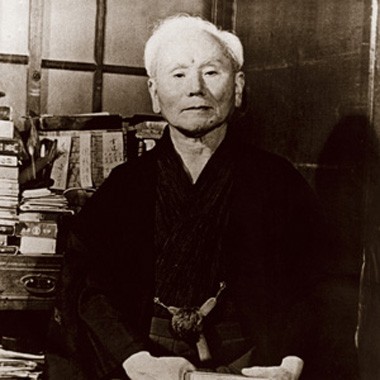
Master Gichin Funakoshi was the first expert
to introduce karate-do to mainland Japan, in 1916. One of the few people
to have been initiated into all the major Okinawan karate methods, Master
Funakoshi taught a synthesis of the Okinawan styles, as a total discipline.
This method became known as Shotokan (literally "House of Shoto," Funakoshi's
pen name). Because of the great popularity of the style in Japan and, later,
around the world, Funakoshi is widely considered to be the "father of modern
karate-do."
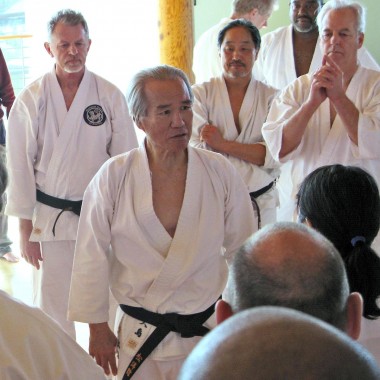
The Influence of Tsutomu Ohshima
Tsutomu Ohshima was one of Master Funakoshi's
last direct pupils (1948-1953), studying under him while attending
Waseda University in Tokyo, Japan. In 1955 Mr. Ohshima came to the United
States and was the first person to teach karate to the US public. By 1959
the Southern California Karate Association (SCKA) was formed, which has
grown over the years to become a nationwide organization, Shotokan Karate
of America, and Mr. Ohshima's influence on karate is felt around the world.
Despite the secluded nature of Mr. Ohshima's early US practices, knowledge
of his teachings quickly spread and membership steadily increased. In
August of 1957 Mr. Ohshima was asked to demonstrate Karate during the
intermission of the annual Nisei Week Judo Tournament, held in Koyasan
Hall in Little Tokyo, Los Angeles. This was the first public demonstration
of traditional Shotokan karate in the United States, and has since become
an annual SKA activity. In 1958 a separate karate tournament was added
as part of Nisei Week under the direction of Mr. Ohshima. The Nisei Week
tournament is now the oldest annually held karate tournament in the United
States, and is still presided over by Mr. Ohshima.
In addition to the formation of the SCKA, several other events of historical
importance to Shotokan Karate of America occurred in 1959. In July the
first US Special Training was held. In December
Mr. Ohshima awarded six of his students the rank of shodan (first degree
black belt), making them the first American-trained black belts in Shotokan
karate. (These honored six were Caylor Adkins, George Murakami, Mas Norihiro,
Jordan Roth, Roe Suzuki, and George Takahashi.)
In 1960, three years after the death of Master Funakoshi in Japan, Mr.
Ohshima led the Waseda Karate Club black belts on a tour of Okinawa and
its karate experts. This was the first official visit by students from
the Japanese mainland since before the Second World War.
A key event in the history of US karate occurred in 1967 when Mr. Ohshima
brought the first organized group of karateka (karate practitioners)
from America to tour and demonstrate in Japan. During their two weeks
in Japan, this group of 36 black, brown, and white belts (including two
from Canada and two from Europe) left a strong impression of the high
degree of development that karate had attained in the United States. This
visit created much interest in American karate among Mr. Ohshima's seniors
in Japan. In 1968 Mr. Ohshima invited Senior Isao Obata, the first Captain
of the Keio University Karate Club, to the United States. During his stay
Senior Obata personally observed and educated Mr. Ohshima's students.
In 1970 five SKA members (John Beltram, Don DePree, Jeff Klein, Ron Thom,
and Henry Wilkerson) were honored by being selected to the United States
team representing America in the first World Karate-do Championships held
in Tokyo, Japan. Their outstanding performance enhanced the international
reputation of Shotokan Karate of America.
Another visit of major importance from Japan occurred in 1973, when Mr.
Ohshima and SKA invited Senior Shigeru Egami to the United States. SKA
organized a massive demonstration for Senior Egami, and he honored us
by lecturing and educating our members.
During 1975, because of SKA's committed involvement with the Amateur
Athletic Union, the entire responsibility for the Third World Karate-do
Championships was thrust upon us. Participants from 35 countries traveled
to Long Beach, California, for the event. It was an enormous and difficult
task, but it ultimately enhanced our goal of spreading the 'way' of karate
by increasing communication, heightening understanding of karate, and
gaining constructive viable relationships with martial artists and leaders
from all parts of the globe.
In 1975 SKA invited Senior Tadao Okuyama to visit the United States to
observe our members. He also personally led Mr. Ohshima in daily practices.
To commemorate our 20th anniversary in 1976 SKA held a memorable celebration,
including a public demonstration and tournament. High-ranking karate experts
from all over the world came to honor the occasion. Various speeches and
awards were made, including a presentation to Mr. Ohshima of a special
plaque by Councilman Bob Farrell on behalf of the City of Los Angeles
for his unselfish devotion to karate, his students, and the public for
over twenty years. We were especially honored by the presence of Senior
Kamata-Watanabe from Japan, who accepted our invitation to attend. Senior
Kamata-Watanabe spoke to our members, emphasizing that all members of
SKA should be proud of our association with Mr. Ohshima for his work over
the last twenty years in developing the strongest and most traditional
karate organization following the teachings of Master Funakoshi.
The highlight of the 20th anniversary took place at the special dan (black
belt rank) promotion personally administered by Senior Kamata-Watanabe
with Mr. Ohshima at the Melrose Dojo in Los Angeles. In the tense atmosphere
of the dojo crowded with SKA black belt observers, three men (Caylor Adkins,
Sadaharu Honda, and Daniel Chemla) became the first individuals outside
of Japan to be awarded the rank of godan (fifth degree black belt), the
highest that can be achieved. This event marked the coming of age of Shotokan
Karate of America!
© 2010 Shotokan Karate of America. All rights reserved. |